| PRED 356 | Methods
of Science and Mathematics Teaching
Chapter 8: Computer Assisted Instruction (CAI) |
1.2.3. Simulations
A simulation is powerful technique that imitates or replicates some aspect of the world. Students are not only motivated by simulations but also learn by interacting with them in a manner similar to the way they react in real situations.

It begins with an introductory section and present the scenario that models part of the world. A cycle begins. The student learns by actually performing the activities. The computer program reacts, providing information or feedback about the effects of the action. Scenario is revised under the new condition. By this way, the loop continues.
In almost every instance, a simulation also simplifies reality by omitting or changing details. In this simplified world, the student solves problems, learns procedures, comes to understand the characteristics of phenomena and how to control them, or learns what actions to take in different situations.
The purpose is to help the student build a useful mental model of part of the world, and to provide an opportunity to test it safely and efficiently.
Simulations differ from interactive tutorials, which help the student learn by providing information and using appropriate question and answer techniques. In a simulation the student learns by actually performing the activities to be learned in a context that is similar to the real world.
Simulations may be used for any of the four phases; that is, they may serve for initial presentation, for guiding the learner, for practice, for assessing learning, or for any combination of these.
It is convenient to divide simulations into four main categories:Physical Simulations. A physical object is displayed on the screen, giving the student an opportunity to use it or learn about it. Typical examples are some scientific laboratory equipment to be used in an experiment.Physical Procedural Situational Process
Procedural Simulations. The purpose of most procedural simulations is to teach a sequence of actions that constitute a procedure. The student learns about how the simulated machine works, not as end in itself, but rather as a means for acquiring the skills and actions needed to operate it. Whenever the student acts, the computer program reacts, providing information or feedback about the effects of the action would have in the real world.
Situational Simulations deal with the attitudes and behaviors of people in different situations, rather than with skilled performance. Situational simulations usually allow the student to explore the effects of different approaches to a situation, or to play different roles in it. In virtually all situational simulations, the student is an integral part of the simulations, taking one of the major roles.
Process Simulations. The student neither participates in the simulations as with situational simulations, nor constantly manipulates it as in physical or procedural simulations. Rather, the students selects values of various parameters at the beginning of the simulation, and then watches the process occur without intervention.
Simulation which is safe, convenient and controllable is an instructional methodology that uses the full power of the computer for instruction. Simulations improve tutorials and drills through enhanced motivation, transfer of learning, and efficiency.
Motivation. The simulations enhance motivation is well known and not suprising.
Transfer of learning. It refers to whether skills or knowledge learned in one situation apply in other situations.
Efficiency. Not only can measure how effectively knowledge, skills, or information transfer one situation to another, but one can also measure how efficient the initial learning experience is with respect to the transfer.
View some of the examples of the simulation. Simulations about Vector , about quadratic equations (Download the necessary files form the linked site, extract the compressed file and run the program by clicking the "exe" file)
The purpose of both simulations and games is to provide an environment that facilitates learning or the acquisition of skills. Simulations attempt to do so by mimicking reality; many simulations are also quite entertaining, but entertainment is not one of their distinguishing features. Conversely, games may or may not simulate reality, but they are nearly always characterized by providing the student with entertaining challenges.
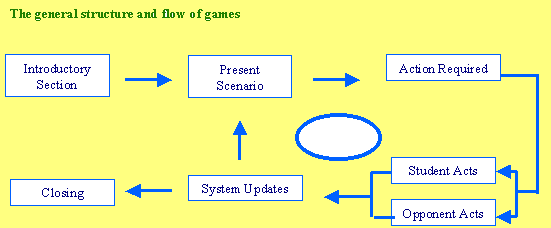
After presentation of the scenario, computer game do an action. Student reacts or students(two sides) react to each other. Then computer evaluate and update stage by allowing going to the next step or repeat the existed step. This loop continues. At the end of the levels, student can exit.
It is difficult to define games precisely. An example for the game is the following:
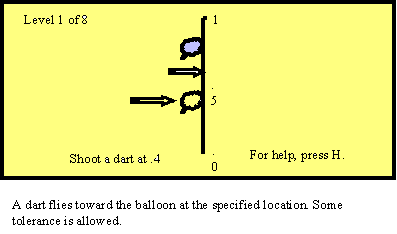
Decimal Darts is an elementary school arithmetic game designed to teach about pints on the number line. At each level, a wall is displayed representing the number line. On the wall are several balloons. The objective of the game is to estimate here on the number line each balloon is located. The estimate is entered, and a dart flies across the screen. If the estimate is accurate, the dart pops the balloon; if inaccurate, the dart sticks into the wall.
The four factors associated with the conclusion of a instructional game are:Games are a powerful instructional tool if used appropriately. It is clear that they have a strong motivating on children and adults alike. However it is important to remember that instruction clothed in game format does not necessarily make the instruction effective. If game satisfies your instructional requirements, it is likely to be successful and popular.Recognizing the winner The reward Providing information (the game has ended to provide feedback to each other player on the progress of the game and on individual performance.) The final message
View some of the examples of the instructional games. Games ArithmATTACK or Lemonade Stand or ... , about mathcar