| PRED 356 | Methods
of Science and Mathematics Teaching
Chapter 7: Cooperative Learning |
 1.1
Definition
1.1
Definition
Cooperative learning is a structured, systematic instructional strategy in which small groups of students work together toward a common goal. Cooperative learning may be considered a subset of collaborative learning. Collaborative learning tends to encompass a variety of group learning experiences, such as peer tutoring, student-faculty research projects, learning communities, and other techniques.
Difference between Cooperative Learning and Group of Activity
Two critical features often distinguish cooperative learning from other forms of small-group instruction:Positive interdependence and Individual accountability Positive interdependence is essential to fostering significant achievement gains. Structures must be built into the learning environment to ensure that all members of a cooperative-learning team feel a sense of responsibility for their teammates.
One way to promote this sense of responsibility is by providing materials that must be shared (materials interdependence). Another way to foster group cohesion is by assigning different members of each team a discrete amount of material to master and then share with teammates (task interdependence). Finally, a small part of each person's grade can depend on each member of the team improving his or her performance on exams (goal interdependence).
A common complaint among those who use small-group instructional procedures is the inequitable distribution of work load across group participants. This problem is usually caused by giving students undifferentiated group grades for papers, presentations, and other course assignments. To combat this phenomenon, the second feature that often distinguishes cooperative learning from other collaborative-learning techniques is the insistence on individual accountability in grading.Individual accountability
Individual accountability helps decrease the sense of inequity perceived by many in traditional small-group procedures, where a significant percentage of the course grade is given to all members of a team, even when one or two of the team members have done most of the work. Forms of small-group instruction that do not contain the two features just describe: should be termed not cooperative learning.
Even though students work together in teams for some percentage of the in-class or out-of-class work, course grades are almost always exclusively determined by individually completed tests, papers, and other assessment procedures.
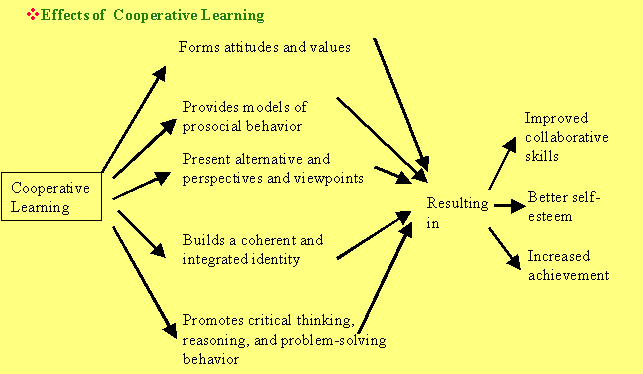
Cooperative learning activities develop in learners important behaviors that prepare them to perform in future successively. These behaviors areAttitudes and Values. Prosocial Behavior. Alternative Perspectives and Viewpoints Integrated Identity Higher Thought Processes Attitudes and Values
Learners form their attitudes and values from social interaction. Although we learn much about the world from books, magazines, and audiovisual media, most of our attitudes and values are formed by discussing what we know or think with others.
Information exchange shapes our views and perspectives. It turns cold, lifeless facts into feelings, and then to attitudes and values that guide our behavior over longer periods of time.
Children learn right from wrong implicitly through their actions and the actions of others that come to the attention of adult family members. Cooperative learning brings learners together in adultlike settings which, when carefully planned and executed, can provide appropriate models of social behavior.
One of your most important roles will be to promote and model positive social interactions and relationships within your classroom.
It is not secret that we form our attitudes and values by confronting viewpoints contrary to our own. Confronted with these alternatives, we are forced into an objectivity necessary for thinking critically, reasoning, and problem solving. In other words, we become less self-centered.
Depending on the merits of what we see and hear, we grow more open to exchanging our feelings and beliefs with those of others. Cooperative learning provides the context or meeting ground where many different viewpoints can be orchestrated.
Social interaction has effect on how we develop our personalities and learn who we are. Social interaction over long periods forces us to see ourselves in many different circumstances. The main result is that these inconsistencies and contradictions in who we are-or think we are- cannot be hidden.
Cooperative learning can be the start of stripping away the irrelevant, overly dramatic, and superficial appendages that mask our deepest thoughts and feelings. Thus we begin to gain an integrated sense of self.
Cooperative learning actively engages our student in the learning process and seeks to improve the critical thinking, reasoning, and problem solving skills of the learner. Critical thinking cannot occur outside a context of attitudes and values, prosocial behaviors, alternative perspectives and integrated identity.
Cooperative learning provides the ingredients for higher thought processes to occur and sets them to work on realistic and adultlike tasks. These higher thought processes –required for analyzing, synthesizing, and decision making- are believed to be stimulated more by interaction with others than by books and lectures, which typically are not interactive.