| |
 1.2
Conducting Discussions 1.2
Conducting Discussions
 1.2.2
Guiding the Discussion 1.2.2
Guiding the Discussion
Once the discussion is started, you must keep it moving briskly in the right
direction.
Skillful Questioning:
One key to successfully guiding the discussion is the skillful
use of questions. The leader’s role is to draw students
out and keep the conversation moving in the direction it should go.
Divergent questions are much more likely to be succesful
than are convergent ones; evalautive questions are likely to be most
valuable of all.
To involve more students, bounce the questions around. Asking
students to comment on other students’ answer can be effective,
such as “Do you agree with Mary, Susie?”.
Alternative Nonquestions.
The following nonquestioning techniques are used to stimulate discussion
and to encourage wide participation.
The teacher’s best technique is to keep silent.
A simple declarative sentence may clear the air and
start things moving again, when a discussion bogs down because students
are unsure of facts or unclear on a particular point. Short explanatory
sentences or restating what you understood a student to say may
be more profitable. For example,
“If I understand you, you believe that...”
“So you maintain that....”
Invite students to eloborate on an expressed idea
may be more effective than are probing questions asked during discussions,
such as
“That sounds like a great idea; would you like to tell us more about it ...”
Encourage students to ask questions. For example, particularly encourage
student-student exchanges. Avoid answering questions with counterquestions.
Creating a supportive atmosphere.
Strive for a supportive atmosphere, accepting all contributions
graciously even when they are not very helpful. Try to ensure
that all are heard with equal respect.
Do not let error pass unchallenged. Always challange
inconsistencies, faulty logic, and superfacilities.
Try to clarify the situation by asking questions such
as
“Just what does that term mean?”
“Exactly what is the issue facing us?”
Keeping on Track.
Bring the group back into focus by asking a question
that deals directly with the topic at hand,
Draw the threads of the discussion together by summarizing or
by asking the recorder to summarize from time to time,
Summary should be brief, well organized, and to the point. Too many
or too long summaries may break up the thread of the discussion and so
do more harm than good. Also harmful are summaries that do not
represent the thinking of all the group.
1.2.3
Evaluating the Discussion.
The value of the discussion will ordinarily increase as the students learn how to carry
on discussion and gain experience. Two of the most effective evaluation techniques are
discussions about the discussion in which pupils examine their own techniques, and free
reaction sheets (rating forms) in which pupils anonymously and briefly state their reaction.
Evaluations of discussion are conducted by using the flow charts or observers’
comments.
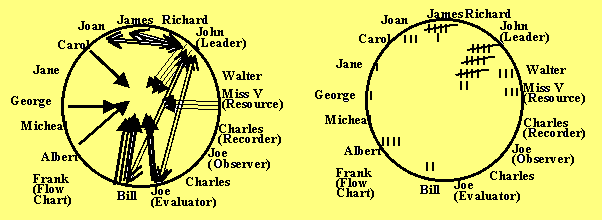
Ask one of the members to act as an observer. Observer comments on the progress of the
discussion and on the participation of the group members are both effective means of making
overtalkative or noncooperative persons aware of their faults.
Discussion about discussion can be two forms such as self-evaluations or completing forms.
Self-evaluations will help improve discussion skills. Students’ self-evaluation
of their discussion can often be enhanced by letting them listen to taped recordings of their
discussions or by flow charts.
Having group members complete a form as simple as the following can be of considerable value:
Did the group discussion do what it set out to do?
In what way did we fall short?
Did we get off the topic?
Did everyone participate?
Did anyone monopolize the conversation?
One of the most effective evaluation techniques is free reaction sheets (rating
forms) in which pupils anonymously and briefly state their reaction.
Discussion
Rating Form
| The Discussion was |
excellent |
indifferent |
bad |
| What I liked best was |
|
|
|
| What I liked least was |
|
|
|
Suggestions:
|
|
|
|
|

|
