| PRED 356 | Methods
of Science and Mathematics Teaching
Chapter 6: Discussion |
1.1 Definition
A discussion is a conversation, not a monologue or a series of questions. A really successful discussion is not only purposeful; it also achieves its purpose. Although it should be purposeful and conclusive, it is not vehicle for expressing the teacher’s point of view or device by which to win support for a particular position. Besides this, the participants need sufficient background to know what they are talking about and base their arguments on fact. A true discussion is
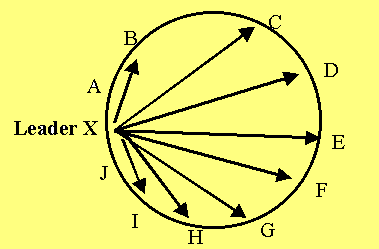
a process- including defending, applying, modifying, explaning, and reworking one’s ideas- that gives students the opportunity to develop concepts with deep personal meaning. a process that is more effective in shaping attitudes, ideals, and appreciations than are the expository teaching strategies. a useful medium for training students in communication skills and for building positive social attitudes and a sense of belonging. give students to practice thinking - to look their own ideas, to formulate and apply principle, to accept immediate feedback from their peers. Satisfactory Patterns of Discussion Flow:
The leader’s questions have elicited general responses and exchanges among students.
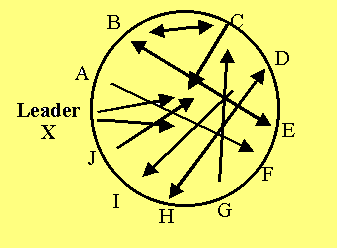
Unsatisfactory Patterns of Discussion Flow:
All conversation emanates from the leader or moderator.
1.2.1 Preparing and Starting for a Discussion
Both teachers and students must be well-prepared for discussion classes if they are to be successful. During the period of preparation, you can make sure that students understand exactly what the point at issue is to be and what their roles in the discussion are.
Starting a discussion may be something of a strain. It may take a little persuasion or some special introductory activity (such as role playing, films, exhibits, tape recording, demonstration, staged incidents, provacative questions etc.). Try to arrange the group in a homey, informal fashion. No matter how dramatic or exciting an initiatory activity may seem, you must be prepared for the students’ response to be negative or for the participants to start off in directions you never dreamed of.The more pleasant the atmosphere, the better chance the discussion has of being successful. A circle is usually the best seating arrangement for a discussion, although any other arrangement that brings the participants face-to-face will do. Be sure the students understand the subject they are to discuss, the procedure they will use in discussing it, and how long they have to conduct the discussion. All of the members of the discussion should know the responsibilities and roles.
Active, purposeful leadership can make the difference between succesful and unsuccessful discussion.Effective discussion leaders start discussion smootly. They introduce the topic succintly but clearly so that everyone understands what is to be discussed and what the purpose of the discussion is, and then they pose provocative opening questions or statements. Competent leaders keep the discussion moving by encouraging all participants to take part and by tactfully bottling up any monologists. Leaders recall the group to the question at hand when the conversation digresses. Good leaders summarize from time to time and help the group members evalaute their progress so as to be sure that everyone understand what has been said and so that no one is left behind. Leaders keep track of the time to be sure that the group can accomplish its task in the time alloted. Effective leaders try to tie together all the ideas, conclusions, and generalizations in a final summary. Discussion leaders should be careful not to dominate discussions. Effective leaders try to see that the ideas of all participants are treated with respect.
Designating someone to act as a recorder or secretary can be helpful in most group discussions. The job of the recorder isto keep a record of the important points and decision made during the discussion. From time to time, at the request of the leader, the recorder may help clarify the course of the discussion, resolve conflicts and confusion, and put wandering discussions back on track by summarizing what has been said.
The ability to speak and listen well as participants in group discussions is a rather difficult skill that relatively few adults have truly mastered. When speaking, participants should try to be clear and precise.
One danger of placing too great emphasis on the way students present their opinions is that they may forget to listen to the discussion.
Your role as teacher is to prepare, execute, and follow up. However, during the actual discussion, your role should be subdued. You will have to act as moderator or chairperson. You must do the following:You should assume the role of a consultant who is always available as a resource person or advisor for whatever contingency might arise.Make sure that the problem to be discussed is properly defined and delimited. Set guidelines. See to it that great errors do not remain unchallenged. Relate the comments to one another and to the central topic.