| PRED 356 | Methods
of Science and Mathematics Teaching
Chapter 5: Problem Solving |
1.4 Designing and Selecting Effective Tasks
Most teacher find their textbook to be main guide to their day-to-day curriculum. Avoid the “myth of coverage”: If we covered it, they must have learned it. Good teachers use their text as a resource and as a basic guide to their curriculum.
Avoid a unit perspective. Avoid the idea that every lesson and idea in the unit requires attention. Identify the two to four big ideas, the essential mathematics in the chapter.
A Task Selection Guide
STEP 1: How is the Activity Done?
Actually do the activity. Try to get “inside” the task or activity to see how it is done and what thinking might go on.
How would children do the activity or solve the problem?What materials are needed? What is written down or recorded? STEP 2: What is the Purpose of the Activity?
What mathematical ideas will the activity develop?Are the ideas concepts or procedural skills? Will there be connections to other related ideas? STEP 3: Will the Activity Accomplish Its Purpose?
What is problematic about the activity? Is the problematic aspect related to the mathematics you identified in the purpose?
What must children reflect on or think about to complete the activity?
Is it possible to complete the activity without much reflective thought? If so, can it be modified so that students will be required to think about the mathematics.STEP 4: What Must You Do?
What will you need to do in the before portion of your lesson?How will you prepare students for this task? What will be the students’ responsibilities? What difficulties might you anticipate seeing in the during portion of your lesson?
What will you want to focus on in the after portion of your lesson?
Problem solving strategies and processes are not so much taught as modeled. Your task as teacher is suggest appropriate strategies and to point them out to students in class discussions as important ways of doing mathematics.
Strategies for Understanding the Problem
Your before actions provide a daily model of problem analysis skills. Let students articulate good understanding strategies such as “Tell what we know” in their own language. Eventually, you can put students in groups and present problems or tasks without having to provide such explicit guidance. Give the responsibility to the students to do the things that you have modeled.
Plan-and-Carry-Out Strategies
Labeling a strategy provides a useful means for students to talk about their methods and for you to provide hints and suggestons. Hints or suggestions about a particular strategy may be appropriate in the before or during phase of your lesson. There are strategies most likely to appear in lessons where mathematical content is the main objective.Looking Back StrategiesDraw a picture, act it out, use a model. (“Act it out” extends models to a real interpretation of the problem situation) Look for a pattern Make a table or chart (Charts of data, function tables, etc.) Try a simpler form of the problem, Guess and check (try and see what you can find out), Make an organized list (This strategy involves systematically accounting for all possible outcomes in a situation, either to find out how many possibilities there are or to be sure that all possible outcomes have been accounted for)
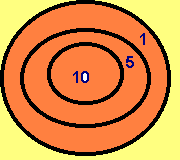
Looking back strategies are things that should always be after a solution has been found:Justify answer, Consider how the problem was solved, Look for possible extensions or generalizations. Example for the Problem Solving StrategiesProblem: “How many number of sum of scores can find a person from the throw to the target in the figure.Strategies for Understanding the Problem
The scores in the target are known. Some of the students find 5,5,1 or 10,5,5 etc. Problem is that how many different results of the sum of the scores are possible?
Plan-and-Carry-Out Strategies
Look for a pattern and make a table or chart. People can take minumum 3 (1+1+1), maximum 30 (10+10+10) score. List or table should show all the score between 3 and 30. Firstly, list the score from the throw which are the same, then different for all the throws. Then so on.Looking Back Strategies
For such a problem what important is where the beginning should be. If there were four throws then how many rows are there in the table? If you couldn’t solve this problem, can you use a problem which has two throws? Write such a problem.
It is important to help students learn to monitor and control their own progress in problem solving. A simple formula that can be employed consists of three questions:The idea is to be persistent with this reflective questioning as students work through problems or explorations. By joining the group, you model questioning that you want the students eventually to do on their own.What are you doing? Why are you doing it? How does it help you?
Students can also be helped in developing self-monitoring habits after their problem-solving activity is over.
Build in success. Plan problems that you are confident your student can solve. Avoid creating a false success that depends on your showing the way at every step and curve.
Praise efforts and risk taking. Students need to hear frequently that they are “good thinkers”, capable of good and productive thought. Be careful to focus praise on the risk or effort and not the products of that effort, regardless of the quality of the ideas.
Listen to all students. Avoid ending a discussion with the first correct answer.