| PRED 356 | Methods
of Science and Mathematics Teaching
Chapter 5: Problem Solving |
1.3 A Three Lesson Format
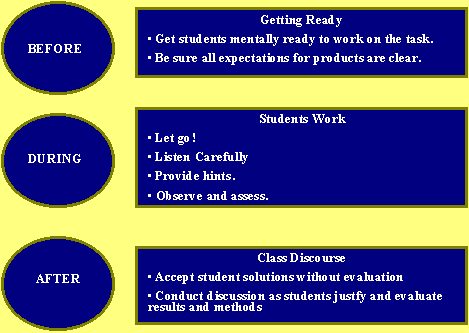
Teaching through problem solving does not mean simply providing a problem or task, sitting back, and waiting for magic to happen. You are responsible for making the atmosphere and the lesson work. To this end, think of a lesson as consisting of three main parts: before, during, and after.
1.3.1 Before Phase
Teacher Actions in the Before Phase
The kinds of things you do in the before phase of a lesson will vary with the task. More likely, you will first engage students in some form of activity directly related to the problem in order to get them prepared.Ali says it is 503 miles to the beach. When we stopped for gas, we had gone 267 miles. How much farther do we have to drive?Begin with a Simple Version of the Task
This problem is designed to help children develop an add-on method of subtraction. Before presenting this problem, have students supply the missing part of 100 after you supply one part. Try numbers like 80 or 30 at first; then try 47 or 62.If your activity or task will present a new concept or if the problem is relatively complex, a preliminary brainstorming session may help get students on the right track before they get too lost in doing the problem.Brainstorm
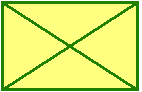
A second-grade teacher in urban school was planning an initial discussion of fractions. On the overhead projector, (s)he drew a simple square with both diagonals.Today we are going to begin talking about fractions. Look at the figure on the screen, and think of one thing you can say about it.
When the task is aimed at the development of a computational procedure, a useful before action is to have students actually do the computation mentally or suggest a ballpark answer.Estimate or Use Mental Computation
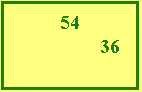
How many small squares (ones or units) will fit in a rectangle that is 54 units and 36 units wide? Use base-ten pieces to help you with your solution.Make a plan for figuring out the total number of pieces without doing too much counting. Explain how your plan would work on a rectangle that is 27 units by 42 units. Prior to estimation or mental computation for this problem, several simpler problems will also help. For example, rectangles such as 30 by 8 or 40 by 60 could be explored.
You must always be sure that students understand the problem before setting them to work.Be sure the Task Is Understood
Consider the task of mastering the multiplication facts. The most difficult facts can be connected or related to an easier fact already learned.
Use a fact you already know to help them solve each of these facts:
4 X 6, 6 X 8, 7 X 6
For this task, it essential that students understand the idea of using a helping fact. They have most likely used helping facts in addition. You can build on this by asking, “when you were learning addition facts, how could knowing 6 + 6 help you figure out 6 + 7?”Students need to be clearly told what is expected of them beyond an answer. It is always a good idea to have students write out an explanation for their solution.Establish Expectations
There is a significant difference between “Show how you got your answer” and “Explain why you think your answer is correct.” With the former direction, students may simply record their steps (First we did..., and then we..) or present their work as self-evident. It is never too early to begin written explanations, even in kindergarten.