
| PRED 356 | Methods
of Science and Mathematics Teaching
Chapter 4: Discovery Learning (DL) |
1.1 Definition
Discovery learning that takes place when students are presented with experiences from which they are asked to derive their own meaning and understanding. Discovery Learning
provides students with opportunities to think independently in order to obtain knowledge for themselves. help students discover how something comes to be known. (How knowledge is formulated through collecting, organizing, and manipulating data) promote higher-order thinking skills such as analysis, synthesis, and evaluation. The role of teacher is to be a catalyst, or change agent.
Whether or not something comes to be known by discovery is directly a function of how well, the teacher sets the stage by arranging an environment that encourages and rewards independent thought and exploration. Teacher help them to find out for themselves, to construct their own knowledge. Teachers ask them to analyze, to synthesize, and to evaluate rather than ask them the knowledge that require recall or remember Purpose and Characteristics
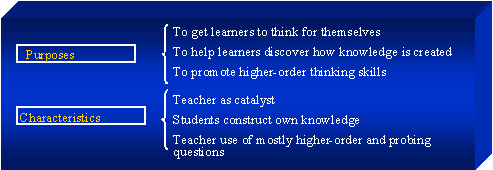
DL might be employed when your instructional goals coincide with its three main purpose:Additionally;To get students to think for themselves, To help them to discover how knowledge is created, To promote higher-order thinking. When it serves the personal and educational needs of both you and your learners. Your learning objectives should be most effectively gained using this alternative.
