
| PRED 356 | Methods
of Science and Mathematics Teaching
Chapter 2: Questioning in the Classroom |
1.1 Introduction to Questioning
Instructors have some difficulties and conditions that forces them to select a questioning technique or to limit their applications. Some of them are:
Context sensitivity,
Practical problems,
Students’ habituation,
Curriculum,
Lack of contact moments,
Problems related to the students who are not able to actuate their prior knowledge,
Intelligence.The most important and effective one among the counted conditions in the teaching and learning is intelligence. Intelligence
- is a collective ability to act and react in changing world.
- is an ability to solve problems or create products.
- includes abstract thinking, problem-solving ability, capacity to acquire knowledge, memory.
Naturally, there isn’t one form of cognition cutting across all human thinking but there are multiple intelligences. Every normal individual posseses varying degrees of these intelligences but the combination of these intelligences are as varied as faces and personalities of individuals.We have different intellectual strengths or "intelligences" and we use them all to varying degrees to acquire knowledge, understand the world, engage in problem-solving, create and to meet the challenges in our daily lives.
Multiple Intelligence (MI) Theory proposes that people use at least seven intellectual capacities. Forms of Intelligences :
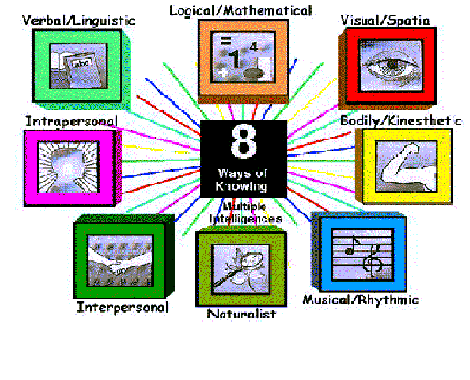
MI theory is a pluralized way of understanding intelligence.
Logical/Mathematical Intelligence is the capacity to use numbers effectively, to reason well and to be sensitive to logical patterns.
For example: Mathematicians, Scientists, Engineers
Verbal/Linguistic Intelligence is the capacity to use words effectively whether orally or written.
For example: Poets, writers, politicians, lawyers
Visual/Spatial Intelligence is the ability to perceive the visual world accurately; involves sensitivity to color, line, shape, form and space.
For example: Painters, sculptors, chess, player.
Bodily/Kinesthetic Intelligence includes expertise in using one’s whole body to express ideas and feelings.
For example: Dancers, actors, athletes.
Musical/Rhythmic Intelligence is the ability to perceive, discriminate, transform and express musical forms.
For example: Singers, composers, musicians
Interpersonal Intelligence is the ability to understand other people; perceive and make distinctions in the moods and feelings of other people.
For example: Social directors, teachers, leaders, sales people.
Intrapersonal Intelligence includes self-knowledge and ability to act on the basis of that knowledge.
For example: Philosophers, mystics, therapists, wise persons
Naturalist Intelligence allows people to distinguish, classify and use features of the environment.
For example: Botanists, geologists, farmers
The purposes of your questionning strategies should be to develop and apply appropriate methods of teaching which is sensitive to the type of the intelligence of your students.
 Multiple
Intelligences
Multiple
Intelligences 